Barla's Research Group



Total Synthesis of Natural Products
Development of innovative synthetic methodologies


Our research focuses on the total synthesis of structurally complex and stereochemically rich molecules, driven by innovative synthetic strategies. Alongside synthesis, we explore new reactions, catalytic methods, and fundamental aspects of chemical reactivity through mechanistic studies. These efforts aim to develop broadly useful synthetic chemistry while enabling collaborations to uncover the biological functions and modes of action of complex molecules.
Our research explores the design and development of innovative synthetic and catalytic methodologies that address key challenges in modern organic chemistry, with an emphasis on efficiency, selectivity, and sustainability. We further apply these methods to the synthesis of natural products and biologically relevant molecules.
Total synthesis plays a crucial role in validating and revising natural product structures through comparison of synthetic and natural compounds using spectroscopic, crystallographic, and chiroptical data. Combined with stereochemical, biosynthetic, and computational approaches, it provides a powerful means of resolving structural ambiguities and advancing natural product chemistry and drug discovery.

Sulfoxonium Ylide Chemistry
We are exploring the utility of sulfoxonium ylide chemistry. By leveraging structurally diverse sulfoxonium ylides, we have developed a transition-metal-free methodology that enables the construction of various novel molecular scaffolds. The synthetic utility of this protocol has been successfully demonstrated through the late-stage functionalization and synthesis of biologically active drug candidates.

Asymmetric Synthesis
Our research also focuses on the development of innovative organocatalytic methodologies for the efficient and selective construction of complex molecular architectures. By harnessing the unique reactivity of small-molecule organic catalysts, we aim to develop sustainable and highly functional-group-tolerant transformations. These catalytic strategies are further applied to the synthesis of biologically relevant molecular scaffolds and bioactive core structures, providing new opportunities in synthetic and medicinal chemistry.
Annulation Reactions
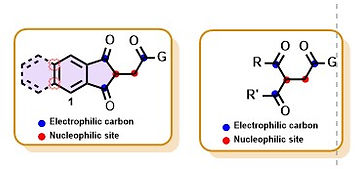
A series of transition-metal-free annulation methodologies have been developed utilizing 2-(2′-ketoalkyl)-1,3-indandiones to construct structurally diverse, complex carbocyclic frameworks. Specifically, this versatile platform provides efficient pathways to dibenzobicyclooctadienones through aryne insertion, functionalized spirocycles via annulation with activated alkynes, and fully saturated spirocyclopentanes with high diastereoselectivity by employing nitrostyrenes as coupling partners.
Strain release Chemistry
Herein, we report the development of structurally diverse, bioactive molecular scaffolds by leveraging the high reactivity of strained ring systems. Utilizing building blocks such as aziridines, bicyclobutanes, and triazinanes, this divergent platform provides rapid access to novel chemical space for medicinal chemistry applications.

Ynone Chemistry
A sustainable, transition-metal-free approachhas been established for the synthesis of diverse heterocyclic frameworks. Utilizing ynones as versatile starting materials, this protocol offers highly efficient and environmentally benign access to functionalized heterocycles without the need for precious metal catalysts."

